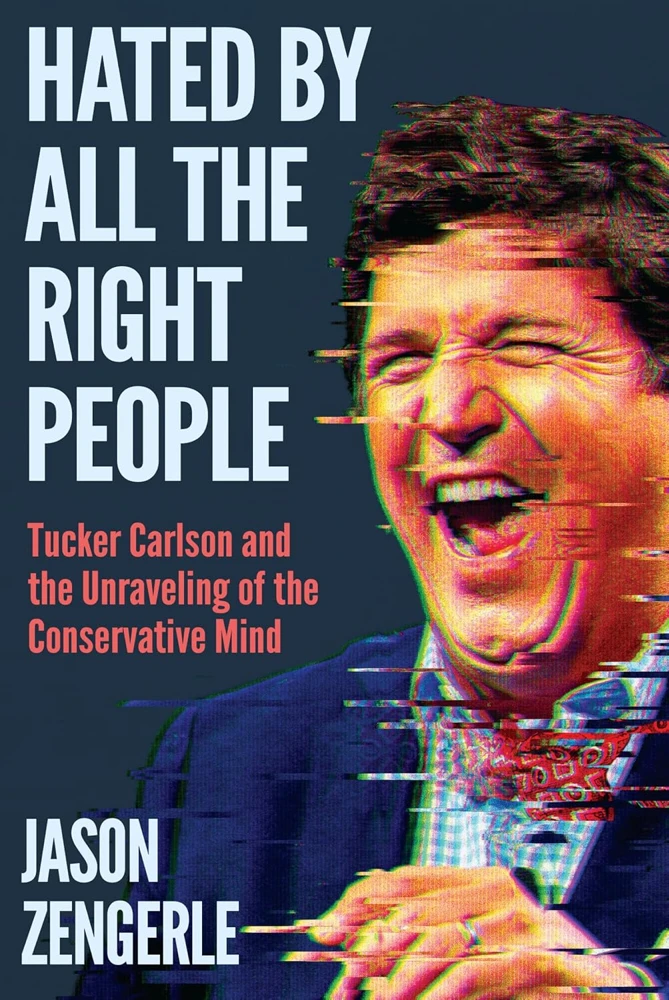
Listing the various ideas and conspiracies Tucker Carlson has embraced over the last decade and a half presents a list of increasingly offensive ideas rooted in opposition to immigrants and the Great Replacement Theory. Yet if you told this list to the 1990s Tucker Carlson who was writing for the Weekly Standard and criticizing Pat Buchanan’s campaigns, he might he rather appalled. What’s clear from Jason Zengerle’s Hated By All the Right People is that Tucker’s views have both shifted over time but also been rooted in the desire to retain popularity, making it hard to fully define where Tucker stands.
In a lot of respects the biggest thing about the book isn’t what Carlson believes or does not believe but rather the decline of conservative media. Even though The Weekly Standard had it’s political ideas and was not shy about hiding it when they started in the 1990s, the magazine also published pieces that were critical of Republicans in Congress. Carlson’s tenure as a magazine journalist stands in stark contrast to his position as a television personality where he constantly felt he needed to serve as a loyal voice for the Republican party, even when the party’s ideas stood in opposition to his personal views, most significantly the war in Iraq in 2003 which Carlson deeply questioned but nevertheless vocally supported on CNN’s Crossfire.
After getting fired from CNN and MSNBC, Carlson tried to call for a new conservative media that was rooted in facts, something he said conservatives lacked in comparison to their liberal. His early morning CPAC speech proposing this idea came right after Obama’s election and proved far less popular than Rush Limbaugh’s angry obstructionism. Nevertheless Carlson at least proclaimed The Daily Caller to be just that, a website rooted in conservative but fact-based journalism. Backed by conservative activist Foster Friess, the site did hire reputable journalists while also embracing a frat-house mentality with free junk food and beer, but quickly Carlson realized the journalism articles weren’t attracting viewers. Rather the sensational headlines and partisan articles brought in far more traffic and money, while also keeping the site somewhat competitive with Andrew Breitbart’s new digital media empire that fully played into the partisan commentary and headlines.
Knowing which way the wind was blowing ultimately led Carlson back out of the wilderness and to his primetime show on Fox News, where he found himself intoxicated with the power of being able to appeal to and influence an audience of one, Donald Trump. Even though Trump’s phone calls unnerved Carlson at first, seeing his ideas come to reality through the Trump administration led him to tailor his monologue to be direct statements at the President.
Even with all the appalling ideas and actions, Hated By All the Right People presents a rather sympathetic view of Carlson. He was truly by all accounts a great magazine journalist and someone who did at times take reasonable stands against bad policy, regardless of who proposed it, but at the end of the book we’re still left with the simple fact that we don’t really know who Tucker Carlson is or what he believes. In the end though, it probably doesn’t matter as much as the broad reality that our media landscape is much worse off now than it was in the 1990s when Carlson found his way to the Weekly Standard. Carlson undeniably played a role in that media shift but he was also not alone in that either.