The idea of the apocalypse and the rapture has been a defining feature for many evangelical Christians for much of the 20th century and throughout that time there always seemed to be times when the Book of Revelations seemed to be coming into reality. Whether it was the World Wars, the nuclear arms race of the Cold War, or by the 1990s the end of that 50 year period of geo-political tensions, Christians of a certain strand found copious amounts of material to draw on for claiming the end of the world was nay.
The problem, of course, is when you make the predictions and they don’t come true, people tend to move away, leaving only the most die-hard believers still committed to the cause. Randy and Vicki Weaver, especially the latter, because some of those true believers as they delved deeper into the apocalyptic predictions as they lived in Iowa during the 1970s and 1980s. For a lot of Iowans the idea of the apocalypse in the 1980s seemed like a very real reality as they grappled with declining farm earnings and bankruptcies. Maybe the world was not fully ending, but many livelihoods were disappearing as farmers simply could not survive declining crop prices. For the Weavers this apocalyptic world view ended with the infamous standoff at Ruby Ridge in August of 1992 that left Vicki Weaver, Samuel Weaver, Striker the family dog, and a US Marshal dead by the time the ten day siege ended.
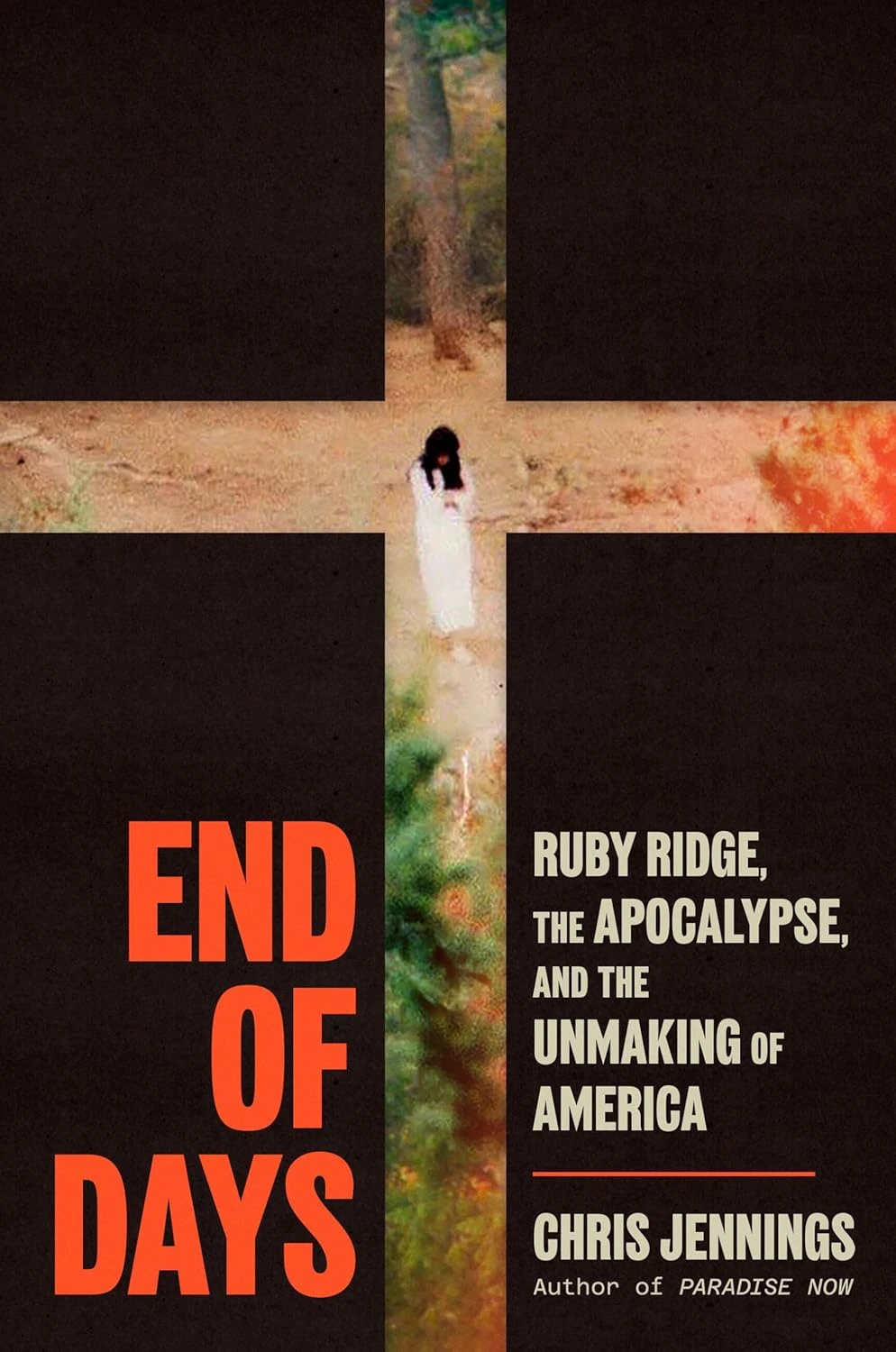
Chris Jennings’ End of Days: Ruby Ridge, the Apocalypse, and the Unmaking of America, provides not only a brisk, detail account of the siege and the legal issues around it, but also the historical context for the Weavers’ religious views that led them to move from Iowa to Idaho and become connected with the white nationalist groups that made northern Idaho their base.
For the Weavers the impetus for their apocalyptic worldview grow out of their shared conservative religious upbringings and inability to find a religious denomination that truly spoke to them. As the 1970s progressed the couple began to follow more of the Christian television programming coming out of the new media empires of people like Jerry Falwell. But even that was not sufficient for Vicki, who went so far as to remove the television from the home along with any photographs, paintings, and dinnerware with paintings of birds to comply with the Bible’s ban on idols. But it wasn’t until the end of the 1970s and the publication of The Late Great Planet Earth that Vicki truly began to embrace the idea that the apocalypse was imminent and she found evidence for it anywhere she looked, where it was the farming crisis or Reagan’s heighten rhetoric about the Cold War, The Late Great’s predictions were seemingly coming true and the family needed to prepare.
As a result they sold the house in Iowa and moved to northern Idaho and a remote property largely cut off from much of the modern world. By 1992 the family’s most significant connections came from Randy’s interactions with the white supremacist Aryan Nations that had its compound at Hayden Lake, south of the family’s homestead. While the family would argue repeatedly that they were not racists, simply living by the principles in the Bible, Randy ran a losing campaign for Sheriff in 1988 that mostly won him votes from the most committed white supremacists and Neo-Nazis in the region.
Yet even with the family’s odious views and Randy’s military background, the family on Ruby Ridge posed little threat outside of Randy’s continual boosting about what he’d do if anyone from the government came onto his property, which multiple federal investigations concluded was probably nothing more than a man who liked to talk. So how did the family become the cause célèbre for right wing groups in the 1990s? Two sawed off shotguns and a missed court date. In 1989 Randy sold two sawed-off shotguns to an undercover ATF informant which was part of a larger campaign by the ATF to get Randy’s help with infiltrating a white supremacist group in Montana. When the plan fell through, the federal government brought the gun charges in the hopes of compelling Randy to become an informant. After a failed attempt to take Randy into custody in 1991, the family retreated to their cabin and would not leave Ruby Ridge again until the seige ended in August 1992. With no telephone and minimal visitors, contacting the Weaves proved difficult. In the Spring of 1992 Randy’s trial date was moved back a day but the letter to him listed the trial date a month later. While the federal government indicated they’d drop the failure to appear charge issued when he didn’t show, the warrant signaled to the Weavers that their beliefs the government could not be trusted were valid. What followed was a series of oversteps and communication failures that led to the US Marshal Service and the FBI’s 10 day standoff with the family after Samuel Weaver and family friend Kevin Harris shot at US Marshals engaged in pre-arrest surveillance.
Jennings’ book provides another addition to the recent historiography re-examining the rightwing movements and events of the 1990s.1 Even though it is difficult to find much sympathy for a couple that expressed racist and anti-semitic beliefs on a regular basis, Jennings’ book does provide an overview of the failures related to Ruby Ridge that made what many would define as entrapment into a national issue that left three people and a dog dead. The book also highlights that paranoia and conspiracies like QAnon spread just as much in the days prior to the internet where the Weavers tapped into an expansive network of religious and racist conspiracies to provide a center for their apocalyptic world view.
Kevin Cook’s Waco Rising: David Koresh, the FBI, and the Birth of America’s Modern Militias, Jeff Guinn’s Waco: David Koresh, the Branch Davidians, and A Legacy of Rage and Jeffrey Toobin’s Homegrown: Timothy McVeigh and the Rise of Right-Wing Extremism were all published in 2024. In addition Heather Ann Thompson’s Fear and Fury: The Reagan Eighties, the Bernie Goetz Shootings, and the Rebirth of White Rage looks at the racial issues of the 1980s in light of Bernie Goetz’s shooting of black teenagers on the New York Subway in 1984. ↩︎