The Apocalypse at Ruby Ridge
Review of End of Days: Ruby Ridge, the Apocalypse, and the Unmaking of America
Review of End of Days: Ruby Ridge, the Apocalypse, and the Unmaking of America
I teach primarly introductory level survey courses and the notes for those courses are a Frankenstein’s monster of assembled sources. I used to try and keep track of what came from where but found the citations too distracting, so I just settled for double checking notes when I add new material in. Every now and then I stumble across something that makes me question what is in my notes and leads me to dig around trying to figure out if I’m saying the right or wrong thing in class. Recently I went down a rabbit hole thanks to Wikipedia entry for Mary Lease because the opening sentence caught me off guard: ...
Dennis Banks passed away on October 29, 2017. On November 1, 2017 I filed a Freedom of Information Act request with the FBI for any files related to Banks. Most of the FBI files related to the American Indian Movement have been public for a number of years but I was curious to see if the FBI would release anything new Banks following his death. After I filed the request the only thing I heard was a notice saying my request was overly broad and I could reduce the scope to enable faster processing. ...
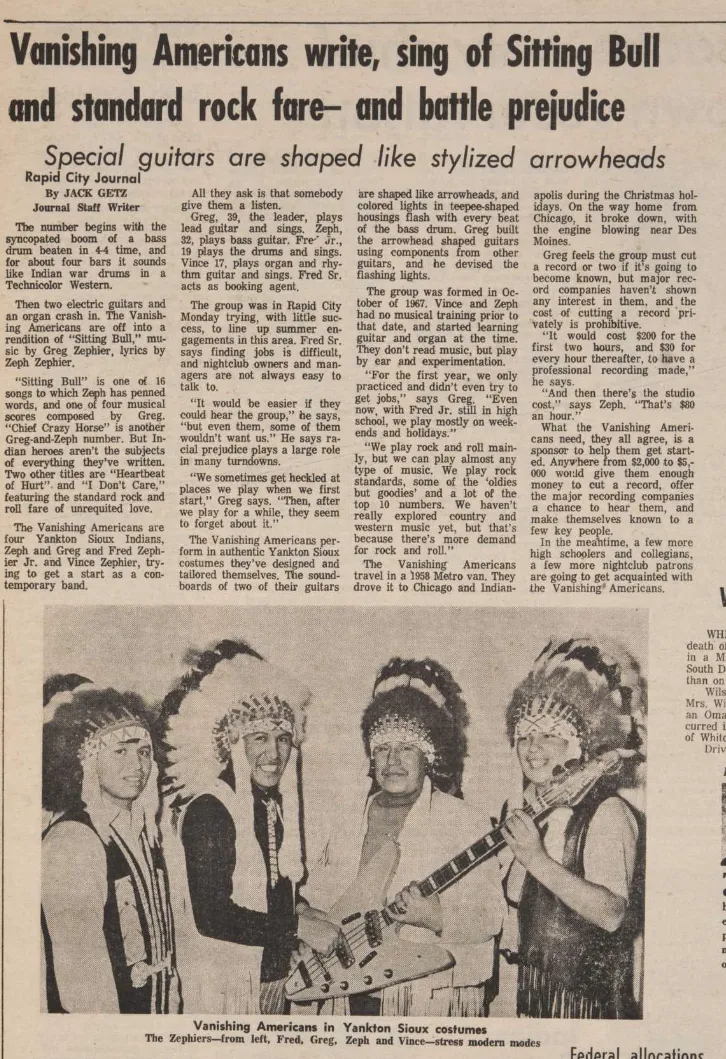
Screenshot of Article detailing Native Rock Band
I’m in Saint Paul, Minnesota for the Western History Association’s annual conference and to explore the archives at the Minnesota Historical Society related to the Wounded Knee Legal Defense/Offense Committee (WKLDOC for short). It’s an expansive archive that collects 149 boxes related to the organization that defended participants in the occupation of Wounded Knee, South Dakota in 1973. Much of it is outside the purview of my dissertation (thankfully I don’t have to read the box upon box of legal proceedings), and given that I only have two days to spelunk through the entire archive, I had to make choices about what I would and would not look at. ...
There’s a fair share of rodeo contestants who have parlayed their time in rodeo into a singing career. Probably most notable is Chris LeDoux, one of the inspirations for Oklahoma State’s own Garth Brooks, who won the 1976 bareback championship at the National Finals Rodeo and sold records out of his truck at rodeo events in the hopes of supporting his rodeo career. LeDoux retained a cult following on the rodeo circuit until Brooks’ debut album in 1989 and the song “Much Too Young (To Feel This Damn Old)” about an aging rodeo contestant who only had “The worn out tape of Chris LeDoux, lonely women and bad booze” pushed him to a wider audience. Yet as evidenced by Armond Duck Chief’s performance at the Indian National Finals Rodeo, the hard scramble life on the rodeo circuit can provide material for countless songs and aspiring songwriters. ...
According to Alexa, the English language version of Wikipedia is the seventh ranked site on the Internet and the only vaguely academic site besides the omnipotent Google on the list. Yet even though Wikipedia and its five million articles have become a ubiquitous part of how we figure out the answer to life’s vexing questions, most people know little about how the content actually gets on Wikipedia. While most theoretically know anyone can edit Wikipedia and contribute additional information or fix errors, few people outside of Wikipedia’s inner circle of active volunteer editors regularly contribute to the site and understand the intricacies of the process. In part this may be the result of technological barriers, but as Tom Simonite noted in an MIT Technology Review article on the “decline of Wikipedia,” Wikipedia’s internal dynamics also play a critical role: ...
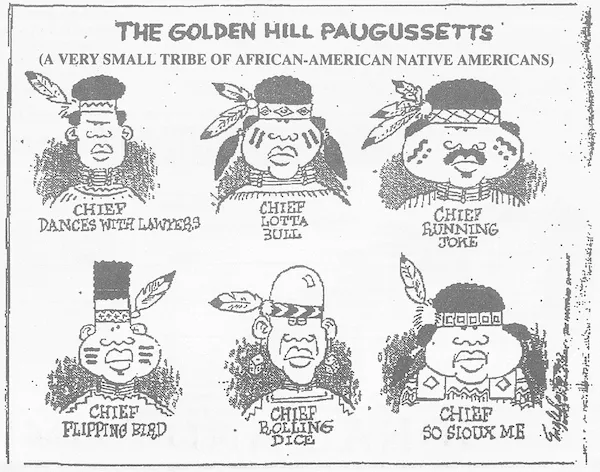
A look at a 1990s anti-Pequot cartoon
One of the many books I picked up today at the library was We Are Still Here: A Photographic History of The American Indian Movement, a good looking large glossy text produced by the Minnesota Historical Society Press which included photographs by Dick Bancroft and text by Laura Waterman Wittstock. Both Bancroft and Wittstock had interactions with AIM during the height of the Red Power period; Bancroft as a sympathetic photographer and Wittstock as a journalist. Yet in both of their introductions to the text, they argue that the death of Raymond Yellow Thunder was the major contributing factor that lead to the occupation of Wounded Knee. Here’s how Bancroft describes it: ...
I’ve been meaning to write an in-depth single about the Bureau of Indian Affairs attempt to change the process for tribes getting recognized and the backlash it’s received in Connecticut since it was announced last summer but simply haven’t had the time (or energy) to get around to it. Because I have no time to write something proper, here’s a basic overview. I. The Current Policy and Changes In June of last year the Bureau of Indian Affairs proposed changing the policy for tribal recognition. To quote the BIA announcement, the current policy is “expensive, burdensome, less than transparent, and inflexible.”1 The current policy requires tribes seeking recognition to provide documents showing “existence since historical contact, prove descent and identity from a historical tribe, demonstrate political structures and influence over their members, and prove they maintained strong community and social ties.” The financial costs, bureaucratic slowness of the process, and inability of tribes to meet the documentary requirements meant that between 1978, when the policy went into affect, and the late 1990s only fourteen tribes had been recognized and thirteen denied acknowledgement.2 ...